
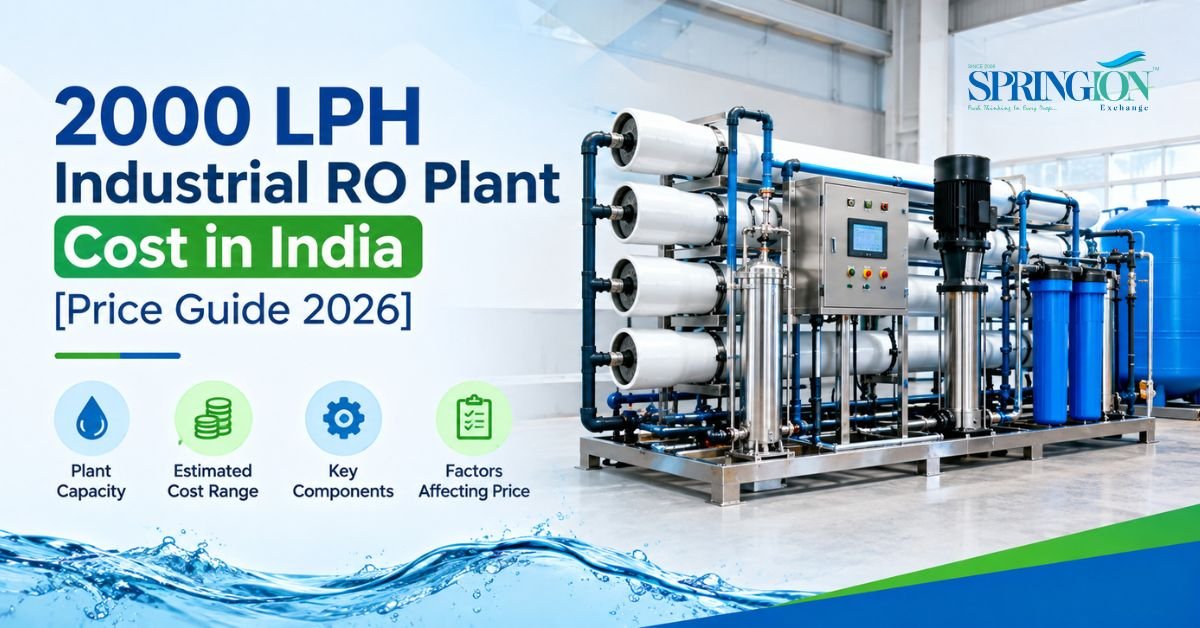
If you are planning to buy a 2000 LPH industrial RO plant in India, the first question is usually: How much will the plant cost?
There is no single price that applies to every 2000 LPH RO plant. Publicly listed Indian systems currently show substantial price variation, with examples ranging from around ₹1.85 lakh to ₹5.5 lakh or more depending on the configuration, material of construction, pretreatment, automation, installation scope, and application. These are market examples, not a universal quotation for every project.
For an accurate 2000 LPH industrial RO plant price, the manufacturer should evaluate your raw-water quality, required treated-water quality, application, and site requirements before preparing a quotation.
This guide explains the major cost factors, what a 2000 LPH RO plant means, what is normally included, how to compare quotations, and what information you should provide to an industrial RO plant manufacturer in India.
How Much Does a 2000 LPH Industrial RO Plant Cost in India?
A 2000 LPH RO plant can be available at significantly different prices depending on what is included in the system.
For example, current publicly listed products include 2000 LPH systems around ₹1.85 lakh, ₹2 lakh, ₹2.5 lakh, ₹3 lakh, ₹4.5 lakh, and ₹5.5 lakh. However, these listings are not directly comparable because their specifications and included equipment differ.
Therefore, the 2000 LPH industrial RO plant cost in India should be treated as project-specific rather than as one fixed market price.
Why can two 2000 LPH RO plants have different prices?
The final price can change based on:
- Raw-water quality
- TDS and hardness
- Turbidity and iron
- Required recovery
- Required treated-water quality
- Pretreatment configuration
- RO membrane selection
- High-pressure pump
- Material of construction
- Automation level
- Instrumentation
- Piping and electrical scope
- Installation and commissioning
- Application requirements
- Transportation and site conditions
A lower-priced system may therefore not provide the same scope as a more extensively engineered industrial system.
If you need an actual project price, the most reliable approach is to share your water test report and plant requirement with the manufacturer.
What Does 2000 LPH Mean in an Industrial RO Plant?
2000 LPH means 2,000 litres of treated water per hour at the plant’s specified operating conditions.
At a nominal production rate of 2,000 litres per hour:
2,000 LPH × 24 hours = 48,000 litres per day
So, if the plant actually operates at its rated production continuously for 24 hours, its nominal production would be approximately 48,000 litres per day, or 48 KLD.
However, a factory should not select plant capacity based only on this calculation. Actual daily production depends on operating hours, feed-water conditions, recovery, maintenance, downtime, and the specific plant design.
For example, a factory operating the RO plant for 8 hours per day would have a nominal production capacity of approximately 16,000 litres during those operating hours.
This is why capacity selection should be based on actual water demand and operating conditions, rather than simply choosing the largest available plant.
What Factors Affect 2000 LPH Industrial RO Plant Price?
The capacity is only one part of an RO plant quotation. The engineering configuration can have a major effect on the final price.
1. Raw-Water Quality
Raw-water quality is one of the most important factors.
A manufacturer may need information such as:
- TDS
- pH
- Hardness
- Turbidity
- Iron
- Chloride
- Silica
- Other relevant parameters
The actual parameters required depend on the water source and intended application.
Borewell water, municipal water, surface water, and other sources can require different treatment approaches.
A water analysis report helps the manufacturer design the pretreatment and RO system appropriately instead of supplying a generic configuration.
2. Pretreatment Requirements
RO membranes need suitable feed-water conditions.
Depending on the water analysis, pretreatment may include equipment such as:
- Pressure sand filter
- Activated carbon filter
- Water softener
- Iron removal treatment
- Cartridge filtration
- Antiscalant dosing
- Other application-specific treatment
Not every 2000 LPH RO plant requires exactly the same pretreatment.
For example, a plant treating relatively clean feed water may require a different configuration from a plant treating difficult borewell water.
This is one reason why comparing two 2000 LPH RO plant prices only by capacity can be misleading.
3. RO Membranes and Configuration
The RO membrane is the primary separation stage of the system.
Membrane selection and configuration depend on factors such as:
- Feed-water quality
- Required production
- Recovery target
- Operating pressure
- Required product-water quality
- Application
A quotation should therefore identify the proposed membrane type and configuration rather than simply stating “RO membrane.”
4. Material of Construction
The material used for the skid, piping, vessels and other components can affect the price.
Depending on the application and engineering requirement, systems may use materials such as FRP, UPVC, or stainless steel in different parts of the installation.
For example, some publicly listed 2000 LPH systems specify stainless-steel construction, while others use combinations of FRP and other materials.
The correct material should be selected according to water chemistry, application, durability requirements, and project specifications.
5. Automation
A 2000 LPH industrial RO plant may be supplied with different levels of automation.
Depending on the design, automation can include:
- Automatic control panel
- Pump protection
- Pressure monitoring
- Flow monitoring
- Automatic flushing
- Level-based controls
- TDS/conductivity monitoring
- PLC-based control where required
More advanced control and monitoring can increase the initial equipment cost but may provide better operational control for applications that require it.
6. Installation and Commissioning
Always check whether the quoted 2000 LPH RO plant price includes:
- Transportation
- Installation
- Piping
- Electrical work
- Civil work
- Commissioning
- Operator training
Different suppliers include different scopes in their published prices.
For example, some listings explicitly mention installation or civil work, while others present a product price without the same project scope.
Therefore, the total project cost can be different from the equipment-only price.
What Is Normally Included in a 2000 LPH Industrial RO Plant?
The exact configuration depends on the water analysis and application, but a typical industrial RO system may include:
| Component | Purpose |
| Raw-water pump | Feeds water into the treatment system |
| Pretreatment filters | Helps protect the RO membranes |
| Cartridge filter | Provides fine filtration before RO |
| Antiscalant dosing system | Helps control scaling where required |
| High-pressure pump | Provides pressure required for RO operation |
| RO membrane housings | Hold the membrane elements |
| RO membranes | Remove a large proportion of dissolved salts |
| Flow meters | Monitor water flow |
| Pressure gauges | Monitor system pressure |
| Control panel | Controls and protects the equipment |
| Skid/frame | Supports the treatment equipment |
| Piping | Connects treatment stages |
The actual equipment list should be confirmed in the quotation because not every 2000 LPH RO plant has the same configuration.
For example, published 2000 LPH systems show differences in the number of membrane housings, pretreatment equipment, pumps, automation, and materials.
Is a 2000 LPH RO Plant Suitable for Your Factory?
A 2000 LPH industrial RO plant may be suitable when a facility needs approximately 2,000 litres per hour of treated RO water under the specified operating conditions.
However, the correct capacity depends on your actual requirement.
Before selecting a plant, consider:
Daily water requirement
How much RO water does your process require each day?
Operating hours
Will the RO plant run for 8, 12, 16, or 24 hours?
Peak demand
Does your factory have periods when water consumption increases?
Storage capacity
Can treated water be stored and supplied when demand increases?
Future expansion
Will production increase in the coming years?
Raw-water quality
Can the selected RO configuration handle your actual feed-water characteristics?
A plant should therefore be sized around the complete water requirement, not simply around the capacity mentioned in a search query.
2000 LPH RO Plant for Different Industrial Applications
A 2000 LPH RO system can be considered for a range of industrial and commercial applications, but the final design should depend on the required water quality.
2000 LPH RO Plant for Textile Industry
Textile processes can have significant water requirements, and treated water quality can influence process performance. The appropriate RO configuration depends on the source water and the specific process requiring treated water.
2000 LPH RO Plant for Pharmaceutical Industry
Pharmaceutical applications can have more demanding water-quality requirements. The RO system may therefore form part of a larger water-treatment train depending on the required final water quality and applicable process requirements.
2000 LPH RO Plant for Food & Beverage Industry
Food and beverage facilities may use treated water for process or utility applications. The required treatment should be determined from the raw-water quality and the intended use of the treated water.
2000 LPH RO Plant for Chemical Industry
Chemical manufacturing can involve different water-quality requirements depending on the process. The RO plant should therefore be designed around the actual feed-water chemistry and application.
2000 LPH RO Plant for General Manufacturing
Manufacturing facilities may use RO water for process water, utility applications, boiler-related applications, or other purposes.
The correct treatment train depends on the specific requirement.
What Information Does a Manufacturer Need for a 2000 LPH RO Plant Quotation?
If you want an accurate 2000 LPH RO plant quotation, provide as much of the following information as possible:
- Water source
- Water test report
- Raw-water TDS
- Hardness
- pH
- Turbidity
- Iron and other relevant parameters
- Required RO production capacity
- Number of operating hours per day
- Application
- Required treated-water quality
- Plant location
- Installation requirement
- Automation requirement
- Any existing pretreatment or storage system
The most useful document is your water test report.
Without raw-water information, a supplier may only be able to provide a preliminary budget rather than a properly engineered quotation.
Have a water test report? Share it with Spring Ion Exchange to discuss the appropriate treatment configuration for your requirements.
2000 LPH RO Plant Operating Cost
The purchase price is only one part of the total cost of an industrial RO system.
Operating expenses can include:
- Electricity
- Pretreatment chemicals
- Antiscalant where required
- Filter and cartridge replacement
- Membrane replacement
- Routine maintenance
- Pump maintenance
- Operator requirements
- Reject-water handling
The actual operating cost depends on factors such as feed-water quality, operating hours, recovery, power consumption, chemical use, membrane condition and maintenance practices.
Therefore, when comparing two 2000 LPH industrial RO plants, it can be useful to consider both:
Initial investment + long-term operating requirements
rather than comparing purchase price alone.
How to Choose a 2000 LPH Industrial RO Plant Manufacturer in India
Choosing the right manufacturer is about more than finding the lowest quotation.
Before finalizing a supplier, check whether the company can:
- Understand your raw-water quality
- Recommend appropriate pretreatment
- Design around your required capacity
- Clearly define equipment specifications
- Provide a detailed quotation
- Explain exclusions and additional requirements
- Support installation and commissioning
- Provide after-sales service
- Supply replacement components when required
- Provide a solution appropriate for your application
For an industrial buyer, engineering suitability and long-term support should be evaluated alongside initial price.
Spring Ion Exchange provides industrial water-treatment solutions based on application requirements and raw-water conditions, with solutions designed for industrial water-treatment needs.
2000 LPH Industrial RO Plant: Buyer Checklist
Before requesting a quotation, keep this checklist ready:
- Water source identified
- Water test report available
- Required capacity confirmed
- Operating hours estimated
- Application defined
- Required treated-water quality identified
- Plant location available
- Installation requirement confirmed
- Storage requirement considered
- Future expansion considered
- Quotation scope compared
- Warranty/service terms reviewed
This information allows the manufacturer to understand your project before recommending the RO system.
Get a Quote for a 2000 LPH Industrial RO Plant
Planning to install a 2000 LPH industrial RO plant for your factory?
Instead of selecting a plant based only on an online price, get the system evaluated according to your actual water quality and application.
Share:
Water source + Water test report + Required capacity + Application + Plant location
with Spring Ion Exchange. Our team can review your requirement and help determine the appropriate industrial RO configuration for your project.
Final Takeaway
The 2000 LPH industrial RO plant cost in India depends on much more than the rated 2,000-litre-per-hour capacity.
Pretreatment, raw-water quality, membrane configuration, material of construction, automation, installation, and application requirements can all influence the final project price.
For this reason, the best way to compare 2000 LPH RO plant prices, suppliers, and manufacturers is to compare the complete technical scope and long-term suitability, not just the lowest equipment price.
If you are planning a 2000 LPH RO plant for your industrial application, start with your water analysis and project requirements before requesting the final quotation.
Frequently Asked Questions
How much does a 2000 LPH industrial RO plant cost in India?
There is no single price for every 2000 LPH industrial RO plant. Current publicly listed Indian examples vary considerably, from around ₹1.85 lakh to ₹5.5 lakh or more, depending on configuration and scope. These published prices should not be treated as a universal quotation.
For an accurate price, the manufacturer should review your water analysis, application, and required system configuration.
What does 2000 LPH mean?
2000 LPH means the RO system is designed to produce approximately 2,000 litres of treated water per hour under its specified operating conditions.
How much water can a 2000 LPH RO plant produce per day?
At a continuous nominal output of 2,000 litres per hour for 24 hours, the theoretical production is approximately 48,000 litres per day, or 48 KLD. Actual production depends on operating hours, feed-water conditions, recovery, and plant downtime.
What affects the price of a 2000 LPH RO plant?
Major factors include raw-water quality, pretreatment, membrane configuration, recovery, pumps, material of construction, automation, instrumentation, installation, and application-specific requirements.
Is a 2000 LPH RO plant suitable for borewell water?
It can be suitable for borewell water, but the configuration should be based on the actual borewell water analysis. Parameters such as TDS, hardness, iron, turbidity, and other relevant characteristics can affect pretreatment and RO design.
How do I get a quotation for a 2000 LPH industrial RO plant?
Provide the manufacturer with your water test report, water source, required capacity, application, operating hours, and plant location. These details allow the manufacturer to develop a more appropriate technical and commercial proposal.
Can a 2000 LPH RO plant be customized?
Yes. Industrial RO systems can be configured according to raw-water quality, application, required treated-water quality, pretreatment requirements, automation, and site conditions.
What should I compare when buying a 2000 LPH RO plant?
Compare capacity, recovery, pretreatment, membranes, pumps, materials, automation, instrumentation, installation, commissioning, warranty, service, and exclusions, not just the purchase price.