
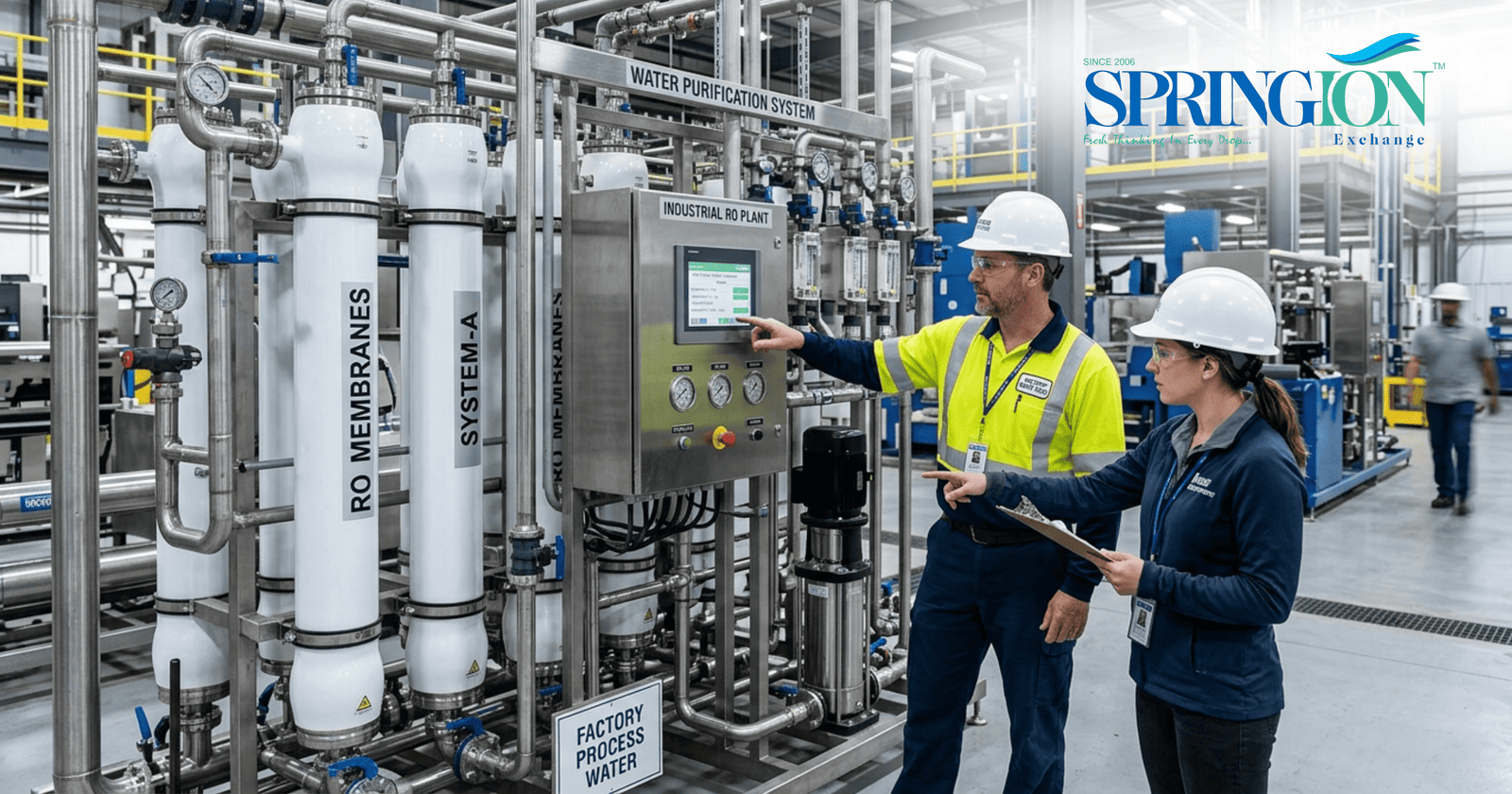
Choosing the right industrial RO plant is not simply about selecting a machine based on capacity. The right system should be designed around your raw-water quality, daily water requirement, industrial application, required water output, available installation space, and long-term operating requirements.
A properly engineered Industrial RO Plant can help industries maintain consistent water quality, address high TDS and hardness, reduce scaling in equipment, and support reliable production operations.
But how do you know which RO plant is right for your factory?
This guide explains the key factors to consider before selecting an Industrial RO Plant and what information you should provide to an RO plant manufacturer before requesting a quotation.
What Is an Industrial RO Plant?
An Industrial RO Plant is a water treatment system that uses reverse osmosis technology to remove dissolved salts, minerals, and impurities from raw water.
The treated water can be used for industrial processing, manufacturing, utility applications, and other processes where consistent water quality is required.
An industrial RO system typically works through a series of treatment stages. Raw water first passes through appropriate pretreatment, after which a high-pressure pump sends the water through RO membranes. The membrane process separates dissolved salts, minerals, and impurities from the treated water.
Depending on the project design and operational requirements, reject water can also be managed or reused.
The exact treatment configuration should be selected according to the raw-water characteristics, required water quality and intended application.
Why Does Choosing the Right Industrial RO Plant Matter?
Water quality can directly affect industrial production, equipment life and operating costs.
Industries may experience water-related challenges such as:
- High TDS affecting production processes
- Hardness and scaling in boilers, pipelines and heat exchangers
- Inconsistent process-water quality
- Increased equipment maintenance
- Specific water-quality requirements for critical manufacturing applications
- The need for better water recovery and efficient water utilization
An appropriately engineered RO plant helps address these challenges by producing consistent treated water suitable for the intended industrial application.
However, there is no single RO configuration that is suitable for every factory.
The system should be selected according to the actual water source, water quality, production requirement, and application.
6 Key Factors to Consider When Choosing an Industrial RO Plant
1. Raw-Water Quality
The first step in choosing an Industrial RO Plant is understanding the water that will enter the treatment system.
Important considerations include:
- Water source
- TDS level
- Hardness
- Other raw-water characteristics identified through water analysis
Industrial water can come from different sources, including:
- Borewell water
- Municipal water
- Surface water
- Other industrial water sources
Different water sources can have different treatment requirements.
For this reason, an industrial RO plant should not be selected only by looking at its capacity. The raw-water quality must also be considered when determining the appropriate treatment and pretreatment configuration.
A recent raw-water analysis report can help the engineering team understand the treatment requirements more accurately.
2. Daily Water Requirement
The next important factor is how much treated water your factory requires.
Your RO plant capacity should be appropriate for your production requirements and daily water demand.
Industrial RO Plant capacity is commonly expressed in LPH, meaning litres per hour.
Spring Ion Exchange currently provides customized Industrial RO Plants ranging from 500 LPH to 100,000+ LPH, depending on production requirements and application.
The current capacity range is broadly positioned as:
| Industrial requirement | Typical Spring capacity range |
| Small manufacturing units and commercial applications | 500–2,000 LPH |
| Medium-scale industries | 2,000–10,000 LPH |
| Large industrial operations | 10,000–50,000 LPH |
| High-capacity industrial projects | 50,000 LPH and above |
Spring’s website associates these capacity ranges with applications including hotels, restaurants, laboratories, food processing, pharmaceuticals, textiles, dairy, chemical processing, pharmaceutical manufacturing, food and beverage, power plants, steel, ceramic and large manufacturing operations.
The final capacity, however, should be determined from your actual water requirement and application rather than selecting a size from a generic capacity table.
An illustrative capacity calculation
Suppose a factory needs 120,000 litres of treated water per day and plans to operate its RO plant for 20 hours per day.
A simple preliminary calculation would be:
120,000 litres ÷ 20 hours = 6,000 LPH
This gives a preliminary production requirement of approximately 6,000 LPH.
This is only an illustrative calculation. The final plant capacity should be confirmed by the manufacturer after considering the actual production requirement, water quality, operating conditions, and future expansion plans.
3. Industrial Application
The required water quality can vary significantly depending on how the treated water will be used.
For example, Industrial RO Plants can support applications in:
- Pharmaceutical manufacturing
- Food and beverage production
- Textile and dyeing
- Chemical manufacturing
- Power plants
- Hotels and hospitals
- Automobile and engineering
- Electronics and precision manufacturing
Spring Ion Exchange states that its Industrial RO Plants are engineered for specific applications rather than supplied as a standard system.
For example, the company’s current Industrial RO page identifies applications such as process water, formulation support and utility applications for pharmaceuticals; ingredient water and production utilities for food and beverage; dyeing and finishing applications for textiles; and boiler-feed and cooling-water applications for power plants.
This is why the manufacturer should understand your process before finalizing the system.
4. Available Installation Space
The physical layout of your factory is another important consideration.
The RO system should fit the available installation area while allowing sufficient access for:
- Operation
- Inspection
- Maintenance
- Servicing
- Installation and commissioning
Spring Ion Exchange states that its Industrial RO Plants can be supplied as skid-mounted or containerized solutions and can be integrated with pretreatment systems, water softeners, UV disinfection, or other treatment stages depending on the application.
When requesting a quotation, it is therefore useful to provide information about the available installation space and plant layout.
5. Operating Cost and Efficiency
The purchase price is not the only consideration when selecting an Industrial RO Plant.
A factory should also consider the long-term operating requirements of the system.
Factors such as:
- Electricity consumption
- Water recovery
- Maintenance
- Water wastage
- Membrane protection
- System operation
- Service requirements
can influence the overall operating value of an RO plant.
Spring Ion Exchange states that its Industrial RO Plants are engineered with a focus on operational efficiency, water recovery, simplified maintenance and long-term performance.
The objective should therefore be to select a system that balances the initial investment with reliable long-term operation.
6. Service and Technical Support
An Industrial RO Plant is a long-term industrial system, so support after installation is an important part of the purchasing decision.
Before selecting a manufacturer, ask what support is included for:
- Installation
- Commissioning
- Operator training
- Technical documentation
- Maintenance
- Spare parts
- Technical assistance
Spring Ion Exchange’s current Industrial RO offering includes installation and commissioning, operator training, technical support, annual maintenance support, spare-parts availability, and technical assistance across India.
A manufacturer that can support the system beyond initial installation can make ongoing operation and maintenance easier.
How Spring Ion Exchange Recommends the Right Industrial RO Plant
Spring Ion Exchange follows an engineering-based approach rather than offering the same standard configuration to every customer.
The company evaluates key factors including:
Water Quality Assessment
The raw-water source, water quality, and TDS are evaluated to determine the appropriate treatment process.
Daily Water Demand
System capacity is selected according to production requirements and future expansion plans.
Application Requirements
The Industrial RO Plant is configured according to the water-quality requirements of the specific industry and process.
Operational Efficiency
The final design focuses on reliable performance, efficient water recovery, and simplified maintenance for long-term operation.
This approach helps avoid selecting a system simply because it has a particular LPH rating.
What Pretreatment Does an Industrial RO Plant Need?
Pretreatment is an important part of an Industrial RO system because it helps prepare the raw water before it reaches the RO membranes.
The exact pretreatment configuration depends on the water source and water characteristics.
Spring Ion Exchange’s current Industrial RO system describes multi-grade sand and activated carbon filtration as pretreatment stages that help protect RO membranes by reducing suspended particles and contaminants before the RO process.
The company’s system also describes automatic chemical dosing, including antiscalant dosing, to help reduce membrane scaling and support stable performance.
Depending on the application, Spring states that Industrial RO Plants can also be integrated with water softeners, UV disinfection or other treatment stages.
The important point is that pretreatment should be selected according to the actual project requirements rather than assuming that every factory needs exactly the same configuration.
How Does an Industrial RO Plant Work?
A simplified Industrial RO treatment process can be understood as follows:
Step 1: Raw-Water Entry
Raw water enters the pretreatment system.
Step 2: Pretreatment
Filtration and other required treatment stages reduce hardness, suspended impurities, and other contaminants before the RO process.
Step 3: High-Pressure Pumping
A high-pressure pump sends the pretreated water through the RO membranes.
Step 4: Reverse Osmosis
The RO membrane process separates dissolved salts, minerals, and impurities from the treated water.
Step 5: Treated-Water Collection
The treated water is collected for industrial processes or utility applications.
Step 6: Reject-Water Management
Reject water can be managed or reused depending on the project design and operational requirements.
The exact configuration and treatment stages depend on the water quality and application.
What Should You Ask an Industrial RO Plant Manufacturer?
Before comparing quotations, it is useful to ask the manufacturer how the proposed system has been designed.
Here are some important questions:
1. Have you evaluated our raw-water quality?
Provide the latest available raw-water analysis so the manufacturer can understand the treatment requirements.
2. How was the required capacity determined?
Ask the manufacturer to explain how your daily water requirement and production needs translate into the proposed LPH capacity.
3. What water quality is required for our application?
The intended application should be clearly explained so that the system can be configured appropriately.
4. What pretreatment is included?
Ask which pretreatment stages are included and why they are required for your raw-water conditions.
5. How will the system fit our available space?
Confirm the proposed dimensions, layout, and access requirements.
6. What operating and maintenance requirements should we expect?
Understand the expected maintenance and operating requirements before purchasing the system.
7. What installation and commissioning support is included?
Clarify the manufacturer’s responsibilities during installation, commissioning, and startup.
8. Is operator training provided?
Proper operation is important for maintaining consistent system performance.
9. What technical support is available after installation?
Ask about technical assistance, spare parts, and maintenance support.
10. Can the system accommodate future requirements?
If your production is expected to grow, discuss future capacity requirements with the manufacturer before finalizing the system.
Common Mistakes to Avoid When Choosing an Industrial RO Plant
Choosing Only by LPH Capacity
Capacity is important, but it is only one part of the selection process.
Water quality, application, installation space, and operating requirements should also be considered.
Ignoring the Raw-Water Source
Borewell, municipal, surface and other industrial water sources can have different treatment requirements.
The manufacturer should understand your source before finalizing the system.
Selecting a Standard System Without Considering the Application
A pharmaceutical manufacturing process, textile operation, food-processing facility, and power plant can have different water requirements.
The system should therefore be configured around the actual application.
Comparing Only the Initial Price
Two systems with similar capacities may differ in treatment configuration, components, installation scope, support and operating requirements.
A proper comparison should consider the complete project rather than only the initial equipment price.
Forgetting About Installation Space
An RO plant must be practical to install, operate and maintain within your factory.
Provide the manufacturer with accurate information about available space and site conditions.
Ignoring After-Sales Support
Installation is only one stage of the project.
Technical support, operator training, maintenance assistance and spare-parts availability can also be important for long-term operation.
Industrial RO Plant Selection Checklist
Before requesting an Industrial RO Plant quotation, prepare the following information:
- Industry type
- Raw-water source
- Latest raw-water analysis, if available
- TDS level
- Daily water requirement
- Required plant capacity
- Intended application
- Required water output
- Available installation space
- Existing water-treatment equipment
- Future production expansion plans
Spring Ion Exchange specifically asks customers to share information such as industry type, raw-water source, TDS level, required plant capacity, application, and available installation space when requesting an Industrial RO Plant recommendation.
Providing this information at the beginning can help the engineering team understand your requirements and recommend a more suitable system.
Industrial RO Plant Capacity Guide
Spring Ion Exchange currently offers customized Industrial RO Plants from 500 LPH to 100,000+ LPH.
The company’s published capacity guide includes:
| Capacity | Example applications published by Spring |
| 500–2,000 LPH | Hotels, restaurants, laboratories, food processing and small pharmaceutical units |
| 2,000–10,000 LPH | Textile, dairy, chemical processing, packaging and commercial facilities |
| 10,000–50,000 LPH | Pharmaceutical manufacturing, food & beverage plants, power plants and large production facilities |
| 50,000 LPH and above | Steel, ceramic, industrial water reuse and large manufacturing operations |
These ranges are a guide, not a substitute for project-specific engineering. Spring’s website states that the final system is selected according to water quality, production requirements, and application.
Why Choose Spring Ion Exchange for an Industrial RO Plant?
Spring Ion Exchange has been providing water and wastewater treatment solutions since 2006 and currently offers customized Industrial RO Plants from 500 LPH to 100,000+ LPH.
Its Industrial RO systems are designed for industries including:
- Pharmaceutical
- Food and beverage
- Textile and dyeing
- Chemical
- Power
- Hotels and hospitals
- Automobile and engineering
- Electronics and precision manufacturing
The company follows an end-to-end engineering process covering:
Water quality assessment → System design → Manufacturing and assembly → Testing and inspection → Installation and commissioning → Operator training and technical support.
Spring also states that its Industrial RO Plants can be supplied as skid-mounted or containerized systems and integrated with additional treatment stages depending on the project requirements.
Get the Right Industrial RO Plant for Your Factory
The right Industrial RO Plant is not simply the one with the highest capacity or the lowest initial price.
The system should be selected according to your:
Raw-water quality + daily water requirement + industrial application + required water output + installation conditions + operating requirements
Spring Ion Exchange’s engineering team evaluates these factors before recommending an Industrial RO solution.
Whether you are setting up a new manufacturing facility, expanding production or replacing an existing RO system, start by preparing your raw-water information and daily water requirement.
Planning an Industrial RO Plant for your factory?
Share your industry type, raw-water source, TDS level, required capacity, application, and available installation space with Spring Ion Exchange.
Talk to an Industrial RO Plant Expert
Get a customized Industrial RO Plant recommendation based on your project’s water quality and production requirements.
Frequently Asked Questions
What is an Industrial RO Plant?
An Industrial RO Plant is a water treatment system that uses reverse osmosis technology to remove dissolved salts, minerals and impurities from raw water. It produces treated water for industrial processing, manufacturing, boiler-feed and utility applications.
Which industries use Industrial RO Plants?
Industrial RO Plants are used across pharmaceutical, food processing, textile, chemical, power, automobile, electronics, hospitality, and engineering industries where consistent water quality is required.
What capacity Industrial RO Plants does Spring Ion Exchange manufacture?
Spring Ion Exchange currently states that it manufactures customized Industrial RO Plants ranging from 500 LPH to 100,000+ LPH, depending on production requirements and application.
Can an Industrial RO Plant be customized?
Yes. Spring states that its Industrial RO Plants are engineered according to factors including raw-water quality, TDS level, application, available space and required water output.
What types of water can an Industrial RO Plant treat?
Spring states that its systems can treat borewell water, municipal water, surface water and other industrial water sources after appropriate pretreatment.
How do I choose the right Industrial RO Plant capacity?
The appropriate capacity depends on factors including your daily water requirement, production requirements, and future expansion plans. Spring’s engineering team evaluates these requirements before recommending a suitable system.
What information should I provide when requesting an Industrial RO Plant quotation?
Spring recommends sharing your raw-water report, if available, industry type, daily water requirement, and preferred plant capacity. Information about the application, raw-water source, TDS level and available installation space can also help the engineering team recommend a suitable system.
Does Spring provide installation and commissioning?
Yes. Spring Ion Exchange states that it provides installation, commissioning, operator training and technical support for its Industrial RO Plants.
Can an Industrial RO Plant include pretreatment?
Yes. Spring’s current Industrial RO offering includes pretreatment such as multi-grade sand and activated carbon filtration and describes automatic antiscalant dosing. Depending on the application, the system can also be integrated with water softeners, UV disinfection, or other treatment stages.
Can reject water from an Industrial RO Plant be reused?
Spring states that reject water can be managed or reused based on the project design and operational requirements. The appropriate approach should therefore be determined as part of the project design.