
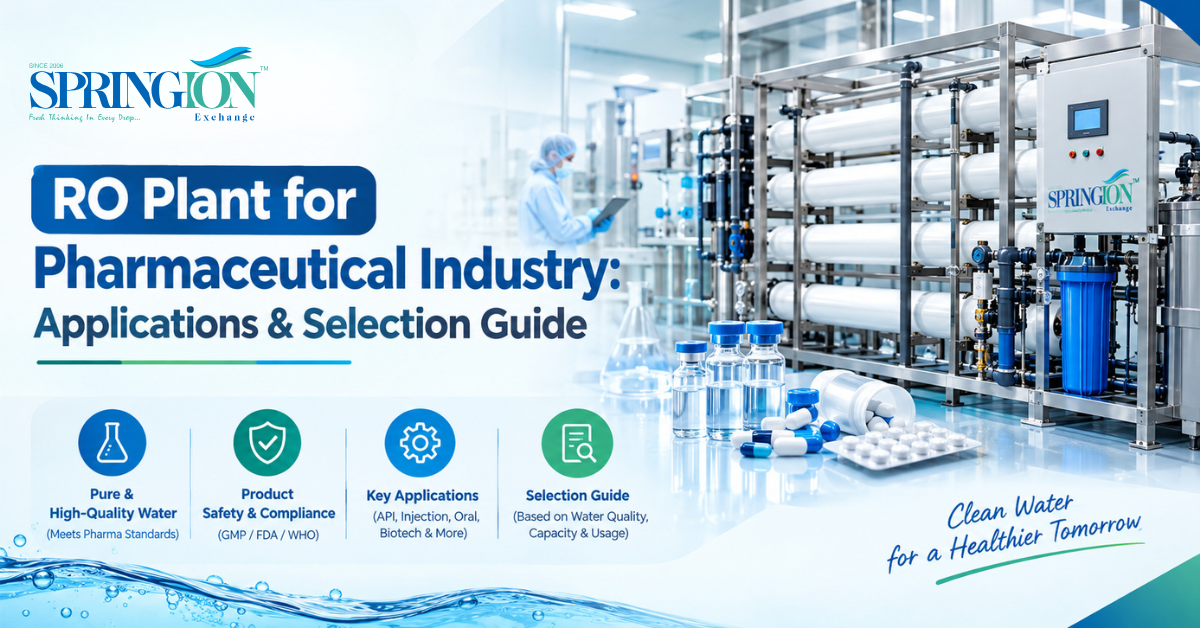
Water quality is critical in pharmaceutical manufacturing because different processes require different levels of chemical and microbiological control. An RO plant for pharmaceutical industry applications can be an important part of the water purification system by reducing dissolved salts and other contaminants from suitable feedwater.
However, RO should not automatically be considered the complete pharmaceutical water system. Depending on the required water specification, feedwater quality, and applicable requirements, additional treatment such as EDI, ultrafiltration, or other qualified purification processes may be required. WHO guidance recognizes RO and RO/EDI among the technologies that may be used to produce purified water.
This guide explains where RO fits into pharmaceutical water treatment, how to select the system, and what manufacturers should consider before installing a pharmaceutical RO plant.
Why Is Water Quality Important in the Pharmaceutical Industry?
Pharmaceutical processes require controlled water quality because variations in dissolved substances, microorganisms, and other contaminants can affect manufacturing processes and water-system performance.
Depending on the application, important water-quality considerations can include:
- Conductivity and dissolved salts
- Total organic carbon (TOC)
- Microbiological quality
- Hardness and other feedwater characteristics
- Endotoxin requirements where applicable
- Stability of water quality during storage and distribution
The required specification depends on the intended use of the water. Therefore, a pharmaceutical company should first establish the required water quality before selecting the treatment system.
What Is an RO Plant for the Pharmaceutical Industry?
A pharmaceutical RO plant is an industrial reverse osmosis system that reduces dissolved salts and other contaminants from suitable feedwater.
A typical treatment sequence may be:
Feedwater → Pretreatment → RO → Further Purification, where required → Storage/Distribution
RO uses pressure to pass water through a semi-permeable membrane. The process produces:
- Permeate: treated water that passes through the membrane
- Reject/concentrate: the stream containing a higher concentration of rejected constituents
The exact configuration depends on the feedwater, required water quality, capacity, and downstream treatment requirements.
Where Is RO Used in the Pharmaceutical Industry?
RO can form part of water-treatment systems used for applications such as:
- Pharmaceutical process water
- Purified water production
- Feedwater preparation for EDI
- Equipment and facility cleaning applications where the specified water quality is appropriate
- Laboratory and utility applications with defined water-quality requirements
The important point is that the required water quality should be determined by the application rather than assuming that RO water is suitable for every pharmaceutical use.
WHO states that purified water can be produced using qualified purification techniques including RO, ion exchange, ultrafiltration and electro-deionization, individually or in suitable combinations.
Can RO Produce Purified Water for Pharmaceutical Use?
Yes, RO can be part of a system used to produce pharmaceutical purified water, but RO alone is not automatically sufficient for every application.
The final treatment configuration depends on:
- Required water-quality specification
- Feedwater quality
- Required production volume
- Pretreatment requirements
- Microbiological-control strategy
- Applicable pharmacopoeial and regulatory requirements
For example, WHO identifies RO/EDI as one possible approach for producing purified water and describes double-pass RO combined with ultrafiltration as one possible approach for highly purified water.
Therefore, the correct question is not simply “Which RO plant should we buy?” but:
“What water quality is required, and what treatment sequence can reliably produce it?”
Is RO Enough for Pharmaceutical Water?
Not necessarily.
RO is highly effective at reducing dissolved constituents, but a pharmaceutical water system may require additional purification and microbial-control measures.
Depending on the application, a treatment train may include:
Pretreatment → RO → EDI / UF / Additional RO → Storage → Distribution
The appropriate sequence depends on the required water specification and actual feedwater conditions.
For Water for Injection (WFI), the requirements are more specific. WHO notes that some pharmacopoeias prescribe or limit the final purification stage and identifies distillation as the preferred technique in its cited guidance.
This is why a pharmaceutical RO system should be designed around the required water grade, not simply around RO capacity.
What Pretreatment Is Required Before a Pharmaceutical RO Plant?
Pretreatment protects the RO membranes and prepares the feedwater for reliable operation.
Depending on the source-water characteristics, it may include:
- Multimedia filtration
- Activated carbon filtration where appropriate
- Water softening
- Antiscalant dosing where appropriate
- Cartridge or micron filtration
- Other treatment based on water chemistry
There is no single pretreatment configuration suitable for every pharmaceutical RO plant.
The design should consider parameters such as TDS, hardness, turbidity, oxidants, silica, iron, organic load, and other relevant feedwater characteristics.
What Water Tests Are Required Before Installing a Pharmaceutical RO Plant?
A water analysis should be completed before finalizing the RO system design.
Depending on the water source and intended application, testing may include:
- pH
- TDS
- Conductivity
- Total hardness
- Alkalinity
- Turbidity
- TSS
- Chloride
- Sulphate
- Silica
- Iron and manganese
- TOC, where applicable
- Microbiological parameters
- Other parameters relevant to the required water specification
WHO specifically recommends considering feedwater quality and its seasonal variation, required water quantity, required water-quality specification, and the purification sequence when configuring pharmaceutical water systems.
How Does a Pharmaceutical RO Plant Work?
A pharmaceutical RO system generally follows these stages:
1. Feedwater analysis
The source water is tested to understand its characteristics and treatment requirements.
2. Pretreatment
Suitable pretreatment reduces the contaminants that could affect RO performance.
3. RO membrane treatment
High-pressure water passes through RO membranes, producing permeate and reject.
4. Further purification
Where required, the RO permeate can be treated through technologies such as EDI, ultrafiltration, or additional purification stages.
5. Storage and distribution
Treated water is stored and distributed through a system designed for the intended application.
The complete water system—not just the RO skid—must be considered when maintaining pharmaceutical water quality.
Why Are Storage and Distribution Important?
Producing suitable water at the RO outlet does not by itself guarantee that the same quality will be maintained until the point of use.
Poorly designed storage and distribution can create risks such as:
- Microbial growth
- Stagnation
- Recontamination
- Deterioration of water quality
WHO recommends considering flow, temperature control, sanitization, appropriate sampling, and suitable equipment design to control microbiological contamination in pharmaceutical water systems.
Therefore, pharmaceutical water treatment should be considered as a complete generation, storage, and distribution system.
What Are the Benefits of an RO Plant in Pharmaceutical Water Treatment?
When correctly designed for the application, RO can:
- Reduce dissolved salts
- Lower conductivity
- Reduce the ionic load entering downstream purification
- Provide consistent treated-water quality
- Serve as feed treatment for EDI or other purification stages
- Form part of a purified-water production system
- Support water-treatment requirements for suitable pharmaceutical applications
The actual performance depends on feedwater quality, membrane selection, pretreatment, operating conditions, and the overall treatment configuration.
RO vs RO + EDI for Pharmaceutical Water
RO and EDI are often complementary rather than competing technologies.
| System | General role |
| RO | Reduces dissolved salts and other contaminants through membrane separation |
| Double-pass RO | Provides additional membrane purification |
| EDI | Further removes ions from suitable RO-treated water |
| RO + EDI | Combines membrane treatment with continuous electrodeionization |
| RO + UF / other treatment | Provides additional purification where required |
WHO recognizes RO/EDI among the possible approaches for producing purified water.
The correct configuration should be selected according to the required water specification rather than choosing a system solely because it has more treatment stages.
How to Select RO Plant Capacity for Pharmaceutical Industry?
Capacity should be based on actual water demand rather than the size of the pharmaceutical facility alone.
Consider:
- Required water quality — What grade of water is needed?
- Application — Where will the water be used?
- Daily consumption — How much water is required?
- Peak demand — What is the maximum expected requirement?
- Operating hours — How long will the plant operate each day?
- Storage capacity — What buffer is required?
- Downstream treatment — Will RO feed EDI or another purification stage?
- Future expansion — Is additional production capacity expected?
WHO also identifies water quantity and required water-quality specification as important inputs when configuring pharmaceutical water systems.
What Factors Affect Pharmaceutical RO Plant Cost?
There is no fixed price for a pharmaceutical RO plant.
The overall cost can vary according to:
- Required capacity
- Feedwater quality
- Pretreatment requirements
- Single-pass or double-pass RO
- EDI requirement
- Membrane configuration
- Automation and instrumentation
- Material of construction
- Storage and distribution
- Sanitization provisions
- Installation and commissioning
- Documentation and qualification requirements
For a broader understanding of industrial RO pricing, see our guide to Industrial RO Plant Cost in India.
Common Problems in Pharmaceutical RO Systems
Some common operational issues include:
Membrane fouling
Contaminants accumulating on the membrane can reduce permeate production and increase operating pressure.
Scaling
Dissolved minerals can form deposits when feedwater chemistry and operating conditions allow precipitation.
Microbial growth
Ambient-temperature purification systems such as RO can be susceptible to microbiological contamination, particularly during low or no-flow conditions.
Poor sanitization
Inadequate microbial-control measures can affect pharmaceutical water-system performance.
Stagnation and recontamination
Water quality can deteriorate after generation if storage and distribution are not properly designed and controlled.
These risks make pretreatment, monitoring, maintenance, and microbial-control measures important parts of pharmaceutical water-system design.
How to Choose a Pharmaceutical RO Plant Manufacturer?
Before selecting a pharmaceutical RO plant manufacturer, evaluate more than plant capacity and price.
Ask the manufacturer:
- Do they design the system using actual water analysis?
- Do they understand the required pharmaceutical water specification?
- Can they explain the complete treatment sequence?
- Is additional purification such as EDI required?
- How will microbial control and sanitization be addressed?
- How will treated water be stored and distributed?
- What instrumentation and monitoring are included?
- What documentation and qualification support are available?
- Can they provide relevant pharmaceutical project information?
A manufacturer should be able to explain why a particular treatment configuration is proposed, rather than simply recommending a higher-capacity RO plant.
Need a Pharmaceutical RO Plant?
The right RO plant for pharmaceutical industry applications depends on the required water quality, feedwater characteristics, capacity, and intended use.
Before selecting a system, share your:
- Raw-water analysis
- Required water quality
- Daily water requirement
- Application
- Existing treatment system, if any
with the treatment-system manufacturer.
Spring Ion Exchange can evaluate the requirement and determine the appropriate treatment approach based on the available technical information.
Frequently Asked Questions
Why is RO used in the pharmaceutical industry?
RO is used to reduce dissolved salts and other contaminants and can serve as an important purification stage in pharmaceutical water-treatment systems.
Is RO enough for pharmaceutical water?
Not necessarily. Depending on the required water specification, additional treatment such as EDI, ultrafiltration, additional RO, or another qualified purification process may be required.
Can RO water be used directly in pharmaceutical manufacturing?
It depends on the application and required water specification. RO permeate should only be used where its quality meets the requirements of the intended application.
What is the difference between RO and RO + EDI?
RO uses membrane separation to reduce dissolved constituents, while EDI provides further ionic purification of suitable feedwater. They can therefore be used together as stages in a water-purification system.
What capacity RO plant does a pharmaceutical company need?
Capacity depends on water demand, peak consumption, operating hours, required water quality, storage and downstream treatment requirements.
Does a pharmaceutical RO system require sanitization?
Pharmaceutical water systems require appropriate measures for microbiological control. The specific sanitization method should be determined according to the system design and applicable requirements. WHO guidance discusses chemical and thermal sanitization and other microbial-control measures.
What water tests are required before installing a pharmaceutical RO plant?
The required analysis depends on the source and application but can include pH, TDS, conductivity, hardness, alkalinity, turbidity, TSS, silica, chloride, sulphate, iron, TOC and microbiological parameters.
What affects the cost of a pharmaceutical RO plant?
Capacity, feedwater quality, pretreatment, RO configuration, EDI or other downstream treatment, automation, materials, storage, distribution, and installation requirements can all affect cost.