
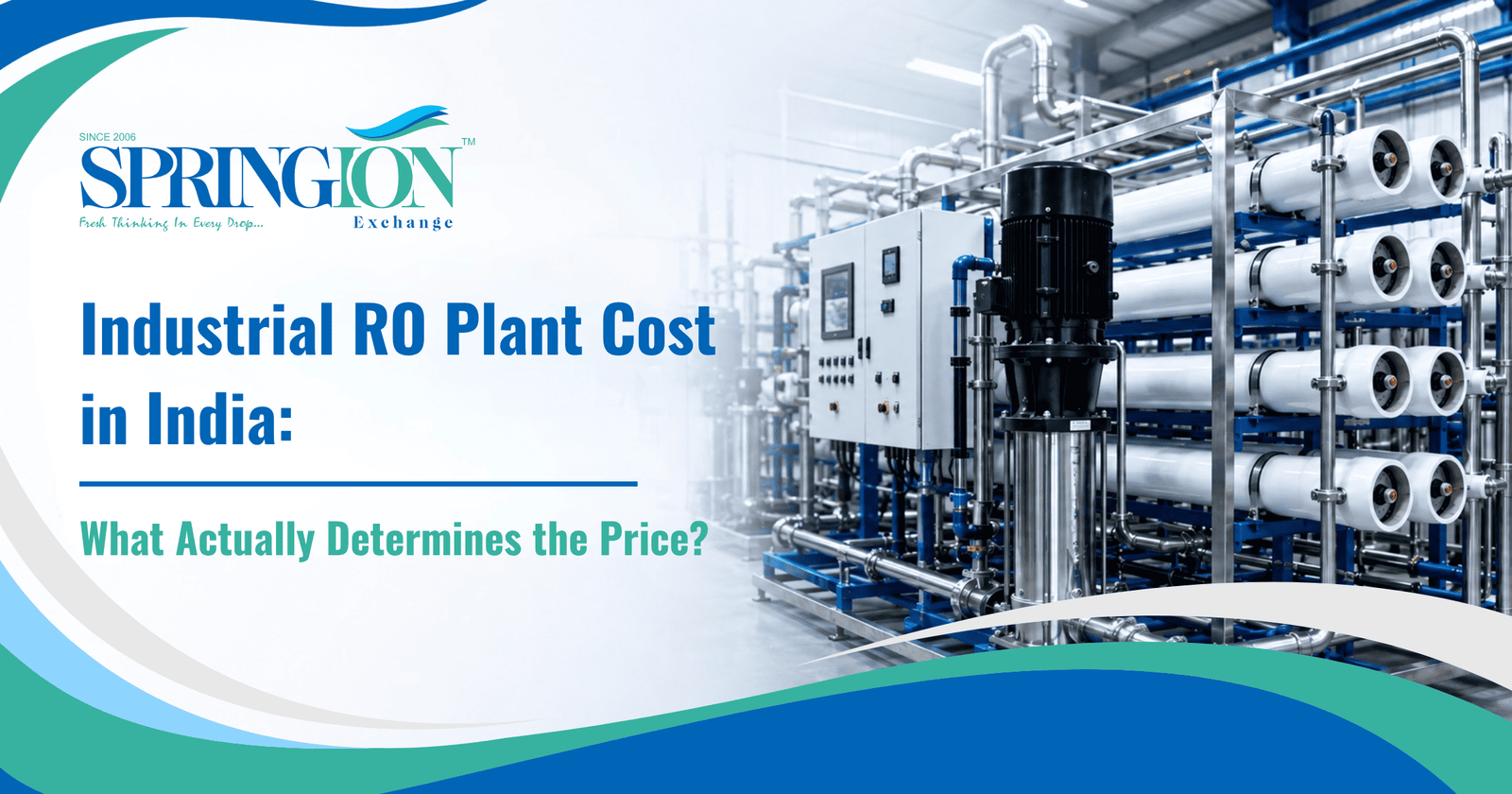
Two industrial RO plants with a similar capacity can have very different quotations. The reason is simple: capacity is only one part of the cost. Raw-water quality, pretreatment, membrane configuration, material, automation, required water quality, and project scope can all change the final investment.
So, what should a factory actually budget for an industrial RO plant? And more importantly, how can you tell whether a quotation offers the right system for your application?
This guide explains the major factors behind industrial RO plant cost in India, the broad market investment range, what can be included in a quotation, and what information you should prepare before approaching an industrial RO plant manufacturer in India.
How Much Does an Industrial RO Plant Cost in India?
There is no single standard price for an industrial RO plant because each system is designed around the site’s water and production requirements.
As a broad budgeting reference, industrial RO systems generally cost between ₹50,000 and ₹40,00,000, depending heavily on the hourly water purification capacity and automation level.
This should be treated only as a generic market-level indication, not a quotation or fixed price.
The final industrial reverse osmosis plant cost depends on factors such as:
- Required treated-water capacity
- Raw-water quality
- Pretreatment requirements
- RO membrane configuration
- Material of construction
- Automation and instrumentation
- Required product-water quality
- Storage, piping and electrical scope
- Installation and commissioning
- Site-specific engineering requirements
Spring Ion Exchange currently offers industrial RO configurations ranging from smaller systems to large-capacity plants and states that systems are customised according to capacity, application and water requirements.
The important point: comparing an RO plant only by its LPH or KLD capacity can give a misleading picture of its actual value.
What Actually Determines Industrial RO Plant Cost?
1. Required RO Plant Capacity
Capacity is one of the first factors considered when designing an industrial RO system.
The requirement may be expressed as:
- LPH — litres per hour
- KLD — kilolitres per day
- m³/hr — cubic metres per hour
But the required capacity should not simply be based on the factory’s average daily consumption.
A proper assessment considers:
- Required permeate production
- Operating hours
- Peak water demand
- Storage capacity
- Production schedule
- Future expansion requirements
Spring Ion Exchange currently describes its industrial RO range across small, medium and large capacity groups, including systems from 500 LPH through 50,000 LPH on its RO purifier page.
A higher-capacity system generally requires greater membrane area, pumping capacity and associated equipment. However, capacity alone does not determine the final plant cost.
2. Raw-Water Quality
This is one of the most important and frequently overlooked factors in an industrial RO quotation.
Two factories may both require a 10,000 LPH RO plant, but their raw water could have very different characteristics.
Depending on the source, the design may need to consider parameters such as:
- TDS and conductivity
- Hardness
- pH
- Turbidity
- Suspended solids
- Iron
- Silica
- Other dissolved constituents
RO membrane performance is influenced by feed-water conditions including salinity, pH and temperature. DuPont’s technical guidance also emphasises that pretreatment requirements depend on the feed-water source, composition and application.
This is why a professional industrial RO plant supplier in India should not recommend a complete system based only on the requested capacity.
The practical rule
The water test report is often more useful than the plant capacity when preparing an accurate RO design.
Spring Ion Exchange states that its team reviews the customer’s water sample before designing the RO purifier around the required daily output.
3. Pretreatment Requirements
RO membranes work best when the feed water has been appropriately prepared.
Depending on the raw-water characteristics, pretreatment may include equipment such as:
- Multimedia or sand filtration
- Activated carbon filtration
- Micron or cartridge filtration
- Water softening
- Chemical dosing
- Other application-specific treatment
Not every RO plant requires the same pretreatment arrangement.
For example, water with significant hardness or suspended solids may require additional treatment before entering the RO membranes. Proper pretreatment helps control fouling and scaling and can support membrane productivity, salt rejection, and operating life.
Spring Ion Exchange’s current industrial RO information includes pre-filtration, carbon filtration, micron filtration, and water-softening options as part of its treatment configurations, depending on requirements.
Therefore, when comparing quotations, ask:
Does the quoted price include the required pretreatment or only the RO skid?
That distinction can make a significant difference to the overall project investment.
4. RO Membrane Configuration
The membrane system is at the heart of an RO plant.
The required configuration depends on factors such as:
- Feed-water characteristics
- Required permeate flow
- Desired water quality
- Recovery requirements
- Operating conditions
- Membrane selection
A larger or more demanding application may require a different membrane arrangement than a smaller, simpler installation.
RO systems separate the feed into a lower-salinity permeate stream and a concentrated reject stream. System recovery, feed-water salinity, and operating conditions influence the design and performance of the membrane system.
For this reason, membrane quantity or brand should not be evaluated independently from the complete system design.
5. Material of Construction
The material selected for the plant can also influence its cost.
Depending on the application, system configuration and project requirements, industrial RO plants may use materials such as:
- FRP
- Stainless steel
- Other application-specific materials
Spring Ion Exchange currently offers FRP and stainless-steel industrial RO configurations.
However, there is no universal rule that one material is correct for every application.
The appropriate choice depends on factors such as:
- Water chemistry
- Application
- Corrosion considerations
- Hygiene requirements
- Installation environment
- Customer specifications
A good quotation should therefore explain why a particular material has been selected, rather than simply presenting it as a premium upgrade.
6. Automation and Instrumentation
Automation can change both the initial investment and the way the plant is operated.
Depending on the requirement, an industrial RO system may include different levels of:
- Automatic control
- Flow monitoring
- Pressure monitoring
- Electrical controls
- Automatic valves
- Safety interlocks
- Instrumentation
Spring Ion Exchange offers automatic industrial RO configurations and describes automated controls as part of its current RO purifier range.
The right level of automation depends on the plant’s capacity, operating pattern, process requirements, and desired level of operator intervention.
For a continuously operating factory, the lowest initial-cost configuration may not necessarily be the most practical choice if it creates additional operational dependency.
7. Required Product-Water Quality
The question is not simply:
“How much water do you need?”
It is also:
“What quality of water does your process require?”
The required water quality may vary depending on whether RO water is intended for:
- General process use
- Manufacturing operations
- Boiler-related applications
- Food processing
- Textile operations
- Pharmaceutical applications
- Other industrial processes
Different applications can require different treatment configurations.
For example, RO may also form part of a larger treatment train. A documented DuPont industrial application in India used UF followed by RO for process and boiler-feed-related water treatment, demonstrating how treatment configuration can vary according to the water source and application.
This is another reason why an online “one-price-fits-all” RO quotation can be unreliable.
Why Can Two Industrial RO Plant Quotations Have Very Different Prices?
Suppose two vendors both quote a 10,000 LPH industrial RO plant.
At first glance, the quotations may appear directly comparable.
But one quotation might include:
- Complete pretreatment
- Higher-grade materials
- Different membrane configuration
- Automatic controls
- Instrumentation
- Installation
- Commissioning
- Site-specific piping
while another may cover only the basic RO equipment.
Therefore, the lower quotation is not automatically the better quotation.
Before comparing prices, compare the technical scope.
A useful quotation comparison checklist
| Compare | What to check |
| Capacity | Permeate output and operating basis |
| Raw water | Water analysis used for design |
| Pretreatment | Equipment included |
| Membranes | Type, quantity and configuration |
| Pumps | Specification and duty |
| Material | FRP/SS and relevant specifications |
| Automation | Manual, semi-automatic or automatic |
| Instruments | What is actually included |
| Installation | Included or excluded |
| Commissioning | Included or excluded |
| Warranty | Scope and duration |
| Service | Technical support and AMC options |
| Civil/electrical work | Included or excluded |
This gives a much more meaningful comparison than price per LPH.
What Is Usually Included in an Industrial RO Plant Quotation?
There is no universal quotation format. The exact scope depends on the project.
However, a complete industrial RO proposal may address several of the following:
- RO skid/system
- Feed and high-pressure pumps
- Membranes
- Pretreatment equipment
- Control panel
- Valves and instrumentation
- Piping
- Storage tanks, where required
- Electrical connections, depending on scope
- Installation
- Testing
- Commissioning
- Operator guidance
- After-sales technical support
Always check the commercial offer carefully to determine which components are included and which are excluded.
For turnkey projects, Spring Ion Exchange states that it supports projects through design, manufacturing, installation, commissioning and ongoing technical support.
Industrial RO Plant Cost: Initial Price vs Long-Term Value
The purchase price is only one part of the financial decision.
An industrial RO plant can also involve ongoing costs related to:
- Electricity consumption
- Membrane replacement
- Pretreatment consumables
- Chemicals, where applicable
- Cleaning and maintenance
- Spare parts
- Operator requirements
- Reject-water management
- Service and AMC
Proper pretreatment is particularly important because fouling and scaling can reduce membrane performance and increase cleaning, maintenance and downtime requirements.
This means a plant with a slightly higher initial investment may be worth considering if its design is better suited to the actual feed water and operating requirements.
The right question is therefore not simply:
“Which RO plant is cheapest?”
It is:
“Which system provides the required water quality and capacity with an appropriate lifecycle cost?”
How to Get a More Accurate Industrial RO Plant Cost
If you are planning an RO system for a factory, prepare the following information before requesting quotations:
Water requirement
- Required RO capacity
- Daily water requirement
- Operating hours
- Peak demand
Raw-water information
- Water source
- Latest water analysis
- TDS/conductivity
- pH
- Hardness
- Turbidity
- Other relevant parameters
Application
- Process water
- Utility water
- Boiler-related requirement
- Manufacturing
- Food processing
- Textile
- Pharmaceutical
- Other application
Project information
- Required treated-water quality
- Available installation space
- Existing pretreatment
- Storage requirement
- Automation preference
- Installation requirements
The more complete the information, the easier it is for an industrial RO plant manufacturer in India to develop a system around the actual requirement instead of providing a generic configuration.
Choosing an Industrial RO Plant for a Factory
If your requirement is specifically an industrial RO plant for factory use, don’t select the system solely on advertised capacity or online price.
Consider these five questions:
- Has the manufacturer reviewed the raw-water quality?
- Is the pretreatment appropriate for that water?
- Is the RO configuration designed around the required output and water quality?
- Is the quotation clear about inclusions and exclusions?
- Will technical support be available after installation?
These questions can help prevent a common industrial procurement problem: purchasing equipment that meets the headline capacity but does not adequately match the actual operating conditions.
Industrial RO Plant Solutions by Spring Ion Exchange
Spring Ion Exchange designs, manufactures and installs industrial water-treatment systems for applications across manufacturing, pharmaceutical, textile, food processing, chemical, healthcare, hospitality and other sectors. Its approach is based on understanding the application and water requirement before configuring the treatment system.
The company supports projects through design, manufacturing, installation, commissioning and technical assistance rather than treating the RO plant as a standalone piece of equipment.
For a factory planning a new RO system, upgrading an existing plant, or evaluating different treatment options, the practical starting point is a water analysis + capacity requirement + application assessment.
Share your water details and required capacity with Spring Ion Exchange to discuss a suitable industrial RO configuration for your application.
Frequently Asked Questions
What is the industrial RO plant cost in India?
There is no single fixed price. Smaller industrial systems generally fall within a few-lakh-rupee range, while larger or highly customised systems can extend into tens of lakhs or more. Actual cost depends on capacity, raw-water quality, pretreatment, membrane configuration, materials, automation and project scope.
What affects industrial reverse osmosis plant cost the most?
The major factors include required capacity, raw-water characteristics, pretreatment, membrane configuration, product-water requirements, material of construction, automation and installation scope.
Does higher RO capacity always mean a higher price?
Capacity is an important cost factor, but it is not the only one. Two plants with the same nominal capacity can have different prices because their feed water, pretreatment, materials, automation and technical configurations may differ.
Why is a water test required before designing an industrial RO plant?
Raw-water composition affects membrane selection, pretreatment, operating conditions and overall system configuration. A water analysis helps the manufacturer design the treatment system around the actual feed water rather than using a generic specification.
Does pretreatment increase the cost of an industrial RO plant?
Additional pretreatment equipment can increase the initial project cost, but the appropriate pretreatment can be important for controlling fouling and scaling and supporting reliable RO operation. The required treatment should be determined from the feed-water characteristics and application.
Is stainless steel necessary for every industrial RO plant?
No. Material selection depends on water chemistry, application, corrosion considerations, hygiene requirements, and project specifications. Industrial RO systems can be configured using different materials according to the application.
What should I compare when selecting an industrial RO plant supplier in India?
Compare the complete technical and commercial scope not just the quoted price. Check capacity, water analysis, pretreatment, membranes, pumps, materials, automation, installation, commissioning, warranty and after-sales support.
What information is required to get an industrial RO plant quotation?
At minimum, provide the required capacity, water source, raw-water test report, application, desired treated-water quality and operating requirements. Additional site and installation information may be required for a complete proposal.